Data Visualization and Temporal Design
How do you visualize something invisible? I gave a guest lecture for Maxim Leyzerovich's class at SVA's MFA Design program, exploring this question with students and tracing humanity's relationship with time through the technologies we've created to measure it.
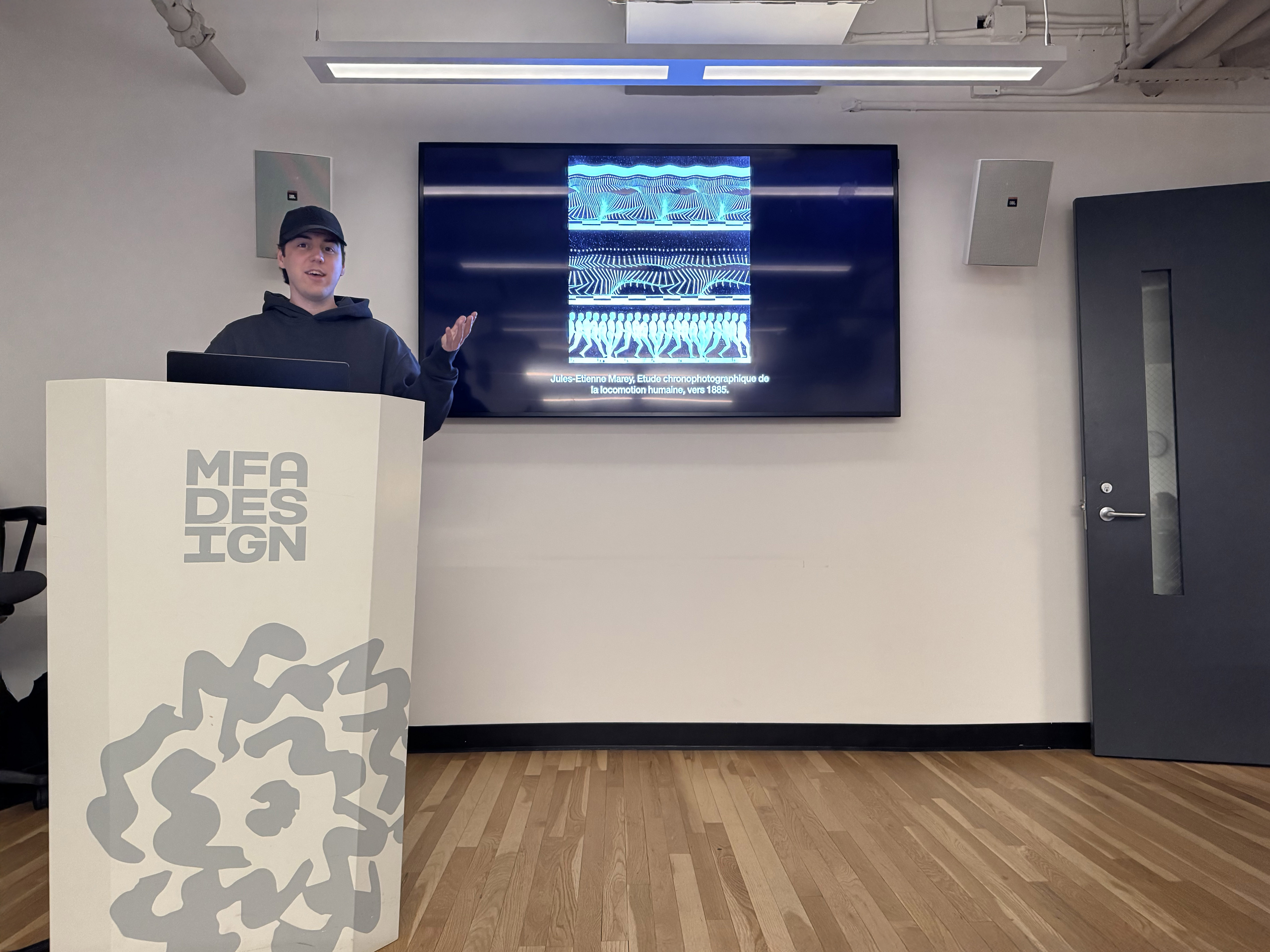
We examined ancient systems like the Metonic cycle, a 19-year pattern the Greeks discovered to sync lunar months with solar years. We looked at Lascaux cave paintings where overlapping animal forms suggest motion captured 30,000 years ago. We discussed how quartz crystals vibrating at 32,768 Hz power our digital clocks, and how Unix epoch time counts every second since 1970.
Mechanical precision eventually gave way to something more urgent. Climate clocks now tick down the years until we exceed critical warming thresholds, transforming time into pressure and warning.
We examined artists and designers who make time visible in unexpected ways. Eadweard Muybridge decomposed a horse's gallop into sequential frames. John Cage's 4'33" frames ambient duration as music. Movie barcodes compress entire films into color timelines. Felix Gonzalez-Torres created synchronized clocks that gradually drift apart.
We looked at how computational artists have worked with time as a medium: Lee Byron's physics engine based clock; Golan Levin's interactive shaders; Vincent Toups explores temporal data patterns in his generative clocks. These artists treat time as a material to shape and manipulate.
It was energizing to work with designers thinking critically about the temporal interfaces we build and inhabit, questioning how we display time and whose time gets valued, measured, and controlled.